Be yourself; Everyone else is already taken.
— Oscar Wilde.
This is the first post on my new blog. I’m just getting this new blog going, so stay tuned for more. Subscribe below to get notified when I post new updates.
THE 1000C
Be yourself; Everyone else is already taken.
— Oscar Wilde.
This is the first post on my new blog. I’m just getting this new blog going, so stay tuned for more. Subscribe below to get notified when I post new updates.
Martin Sheen’s “The Way” follows Thomas Avery, a father who undertakes a pilgrimage called “Camino de Santiago”, following his son’s passing on the same pilgrimage. I chose Thomas’ journey to analyze in the light of Jim Martin’s Paths to God. I believe that Thomas initially follows the Path of Disbelief. Characterized by not finding any appeal in organized religion, it is evident that Thomas follows this path in the beginning of the film. Upon learning of his son’s passing, the pastor seeks to comfort Thomas by asking to pray for him, to which Thomas replies, “what for?” This response shows that Thomas thinks that prayer is a waste of time and inconsequential. Having his life be punctuated with grief, with his wife’s passing and now his son, it can be assumed that any thoughts Thomas might have about God would be laced with resentment for taking his loved ones away. However, with the undertaking of this pilgrimage, Thomas unknowingly goes on a path of exploration. This Path of Exploration, characterized by a search for a religion that fits them, was walked with every step in Thomas pilgrimage. Along the way, he made friends with three other travelers making the walk for their own individual reasons, but all who helped each other reach their common destination. At the end of this journey, Thomas crosses himself at the church, signifying a connection with Christianity. He sees his son smiling at the Church and finds some sort of comfort. As he releases the last of his son’s ashes into the ocean, Thomas’ spiritual journey seems to have come full circle. His reason as to why he went on the pilgrimage in the first place was unknown to him. However, at the end of the challenging journey, he found some sort of closure and better understanding of his son through walking in his shoes. The link to Jim Martin’s Paths to God comes from religion’s role in helping Thomas accept his son’s death.
Six Paths to God
The Path of Belief
Born This Way – Lady Gaga
I chose this song because the people on this path of belief has had religion in their life from a very early age, and thus they were born into it.
The Path of Independence
I Want to Break Free – Queen
In this song, Queen sings about breaking free from the “lies”, which is what persons on the path of independence might view religion as.
The Path of Disbelief
I knew You were Trouble – Taylor Swift
The Path of disbelief deals with concluding that God does not exist, so I chose this song as I imagine those who walk this path directing this song to God.
The Path of Return
Back to You – Selena Gomez
In this song selena sings about returning to a past lover, in the case of the path of return, this represents the individual’s relationship with God.
The Path of Exploration
Into the Unknown – Idina Menzel
I chose this song because in Frozen 2, Elsa was longing to discover what was calling to her, even though she was content with her current life. Just like those who walk the path of exploration, the desire to experience new and different religious traditions, i.e the unknown, is similar to elsa’s journey.
The Path of Confusion
Million Reasons – Lady Gaga
In this song, Lady Gaga sings about a lover who gives her “a million reasons to let them go”, but all she needs is one good one to stay. Thus I chose this song to represent the path of confusion where they long for an understanding and close relationship with God.
As Cone states, the concept of the cross and the image of the lynching tree might not often be thought of together. However, upon examination their relationship is clearly made apparent and sparks a discussion about Christianity in America today. The statement given in the prompt says that the cross and the lynching tree needs to be seen together to genuinely understand Christian identity in America and heal the racial divide in society. The cross to many is a romanticized symbol of salvation, that God so loved the world he gave his only begotten Son so that mankind can be saved. While many believe this, the acceptance of this truth somewhat erases the brutal and cruel display of torture that the crucifixion represented. When thinking about the cross in this way, the comparison to the lynching tree is easier to understand. The genuinely horrifying recollection of disfigured black lynched bodies swaying in the wind, as onlookers gazed in enjoyment and a sense of “victory” is not something that can be easily forgotten, no matter how much society seems to sweep it under the rug. Black identification with Jesus Christ, the suffering messiah, seems to be more direct because of the parallels faced by Christ on the cross and their lynched black ancestors. These were both chilling and gruesome public displays of torture and execution. Relating this history to present day comes in the renewed forms of black lynching that is experienced today. Understanding the racial divides can only come from acknowledging the terrible injustices faced by black people that can be related to Jesus Christ. Ultimately, the symbol of the cross being transformed into “triumphant beauty,” as Cone calls it, gives hope to overcoming legacies of white supremacy that was explicitly displayed throughout history – whose remnants are still being felt today.
The word of God is offensive, because it is not what we want to hear. Harsh truths such as corrupt preachers oppressing marginal people under the guise of God’s will is not what one usually envisions when he thinks of the word of God. However, it remains a reality. Just as the lynching tree which provides a 19th century parallel to the crucifixion of Jesus Christ, is a harsh reality that must not be forgotten.
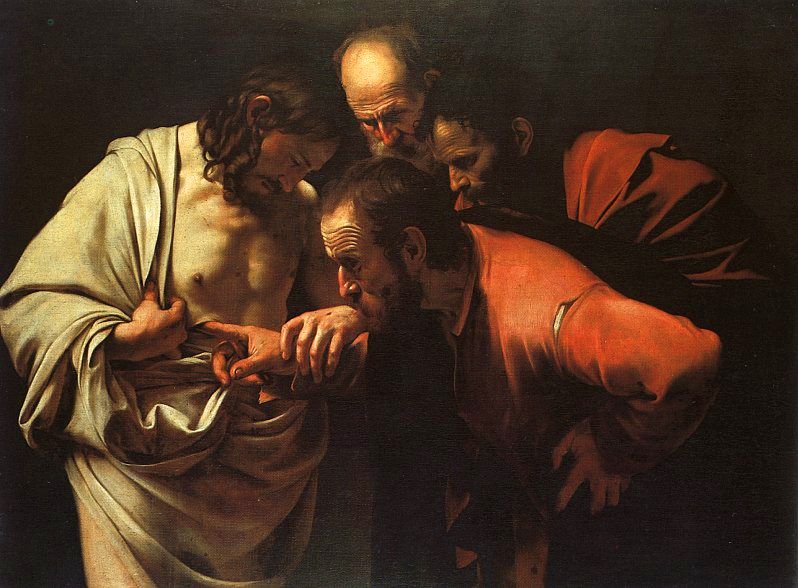
This relates to Goizueta’s denial of the suffering and denial of the poor. Often times, people feel uncomfortable to see these vulnerable persons such as the poor as their existence is a “mirror of our own soul.” However, as Goizueta asserts, “by denying death, we inflict it.” The relation to the previous discussion comes from the Christ’s resurrection. “Christ’s bodily resurrection involves the realization that past injustices are never erased by future victories.” This quote from Goizueta can be linked to the past injustices of white supremacy and lynching. At the very base of this issue is not running from what makes us uncomfortable, but confronting it just as Christ did for his disciples upon his resurrection, grabbing Thomas’ hand and forcing it into his wound, showing that it is real.
Reference “The Incredulity of Saint Thomas” by famous painter Caravaggio.
In the perspective of African women, it is important to note the oppression which they face. Women in the African community, and historically, all women, have been marginalized and viewed as inferior. Due to this oppression, Nasimyu-Wasike says that they have learned tolerance. In the study conducted, Jesus for the African women in the prayer group is their savior. He empowers them to deal with the hardships of daily life through his light and grace. The common denominator in all of their responses is that he enables them to carry on as the “victorious conqueror of all evil spiritual forces.” It is apparent that Christ serves a multitude of roles in their lives, that of a nurturer, liberator and a giver of hope.
In the context of Bantu Christians, “Christ Our Ancestor” refers to a living presence rather than a memory. This is significant in their invocation of Christ on a daily basis, or invoking his presence for meals and communion. I found this contrast to be helpful in making the distinction between the African perspective vs that of Europeans. This is reminiscent of the Christ for African women, as he is called upon daily to help them with their hardships. The difficulties faced by not just African women, but Africans on the whole I believe are a strong reason for their identification with Christ, their ancestor, on a daily basis. They have a firm belief in that “existence would be devoid of all sense and meaning outside their community,” meaning that their lives are very much intertwined with that of their community, with Christ being the mediator.
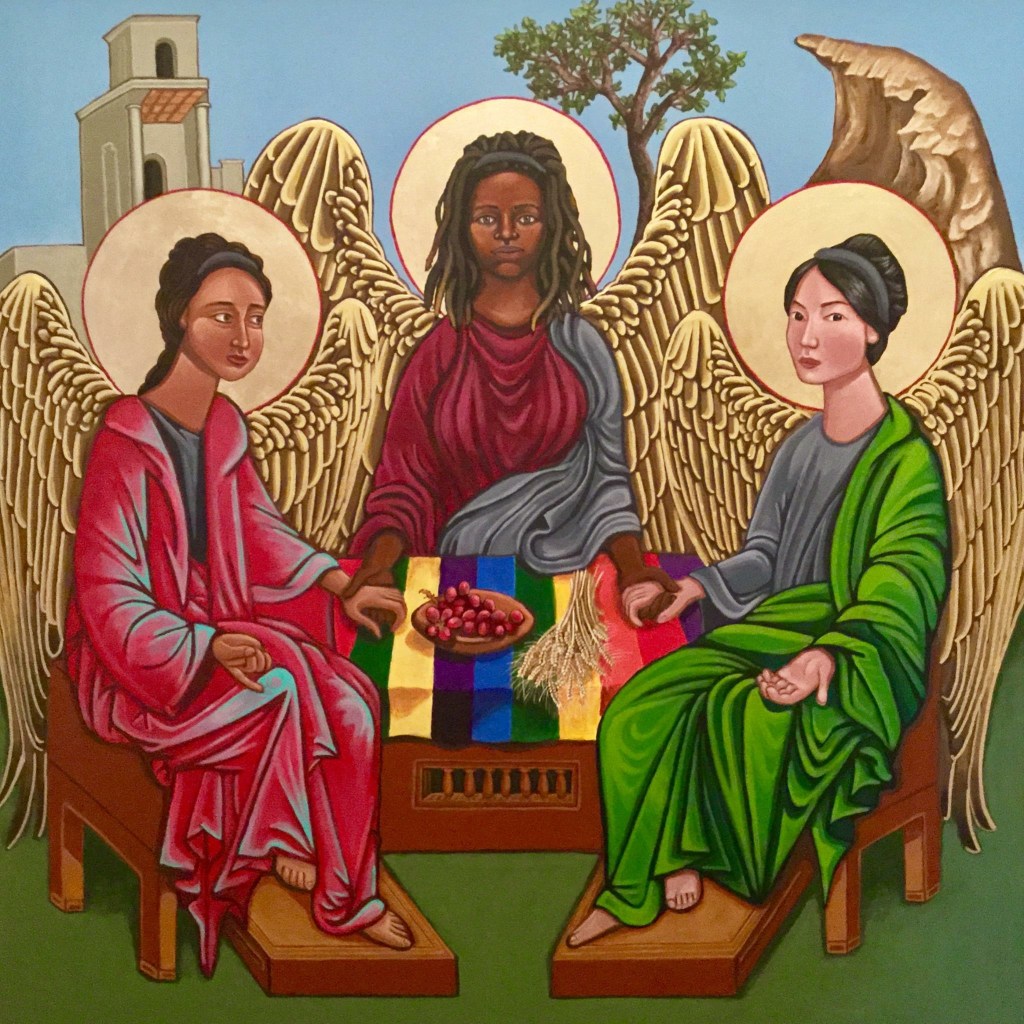
The painting I have chosen is “The Trinity” by Kelly Latimore. This image was very appealing to me, and it stood out from the others. This is because it goes against the idolatry of envisioning the Father and the Son as white men, and the Holy Spirit as a white dove. In the painting, we see not just three women, but three women of color. Despite their differences, however, they are all winged and joined in hands around a table. The rainbow tablecloth also grabbed my attention upon viewing.
I like this depiction of the Holy Trinity because it really is not like any representation I’ve seen before. I think that Father is in the middle, the Son is to the right, and the Holy Spirit is to the left. This is because both the Father and Son has their gaze set on the viewer, looking at humanity, while the Holy Spirit is glancing in the direction of the Father and the Son. This is representative of mankind’s fixation on God and Jesus Christ as the Father and the Son, but not giving that much attention to the Holy Spirit who is equal to its counterparts. Also, the fact that they are all joined with their hands together shows that they are all bonded, and that if one person breaks the bond, the entire bond no longer exists because they are all the same. This speaks to the consubstantial nature of the Holy Trinity, also expertly depicting that while God may come in different forms, of the Son and the Holy Spirit, they are all still God. The inclusion of diversity in this painting adds a more modern touch and understanding of the Trinity.
According to the documentary, the Vincentian question is what must be done, and how can I be of service to others. St. Vincent de Paul had a tireless zeal to help in the ways he can, establishing charities and confraternities that assisted many, especially the poor. He utilized his natural talents and channeled them into his mission. Thus, to be Vincentian is to uphold that charisma. To ask yourself, what must be done. To me, this does not have to be revolutionary. It is the many little ways in which you make the lives of those around you marginally better, that makes a big difference in the end. At SJU, the little things like helping a classmate with their work is reminiscent of the Vincentian virtue of gentleness. This is all encompassed by following one of Vincent de Paul’s actions – love all human beings.
Luther was angry with the Pope selling indulgences, referred to as “Papal Indulgences” at the time, which were essentially payments for the remission of punishment on sins.
He views Christian liberty as one which should be exercised in order of following and serving Christ, “through penalties, death and Hell.” This was the theory he utilized in condemning the sale of these indulgences as he stated they provide a “false security of peace.” Luther also believes that by acts of love, does a man get better, and indulgences only free them of penalties, and does not in fact make the buyer any better.
I approve of Luther’s ideas as I also do not support indulgences. I think that Luther’s 95 Theses made sense and was definitely very impactful in the Reformation of the Church at the time.
We stan Jesus Christ, who is all God and all Man – just like us humans and just like God our Father. Born to the Virgin Mary and sent by God, he died for the sins of humankind. Make no mistake, while he represents both natures, he is one entity with each nature not taking away from the other. This is so as we are told by the prophets, the Lord JC himself and the Creed handed down to us.
For the kingdom of heaven is like a man with a small business. He hired an assistant, with whom he agreed to paid minimum wage. As the business expanded, he needed more help. A few months later, he hired a secretary and agreed to pay her minimum wage. As time went on, they needed help with the files. After a few more months, he hired a file clerk, and paid him minimum wage. When the assistant was generating payroll for that month the file clerk was hired, she grumbled and questioned the boss as to why the janitor and the secretary are getting the same pay as her, she’s been working there since the beginning. To which the boss replied, you all agreed to be paid minimum wage, it is lawful and just. Am I not allowed to do what I choose with what belongs to me? Or are you envious because I am generous.
The word “prophet” translates to “one who speaks for another,” they are essentially the intermediaries between God and Humanity. Biblical prophets include famous names such as Jeremiah, Isaiah and Moses. If the definition of a prophet is one who stands up for what is right and who speaks truth to power, then Dr. Martin Luther King Jr. was without a shadow of a doubt a prophet. His contribution to combating racial inequality in a time of sweltering segregation and racism surely exhibits how he has historically stood up to power and challenged social structures, while incorporating the word of God.

 NIKHIL SANKAR